Loading your workspace…
All markets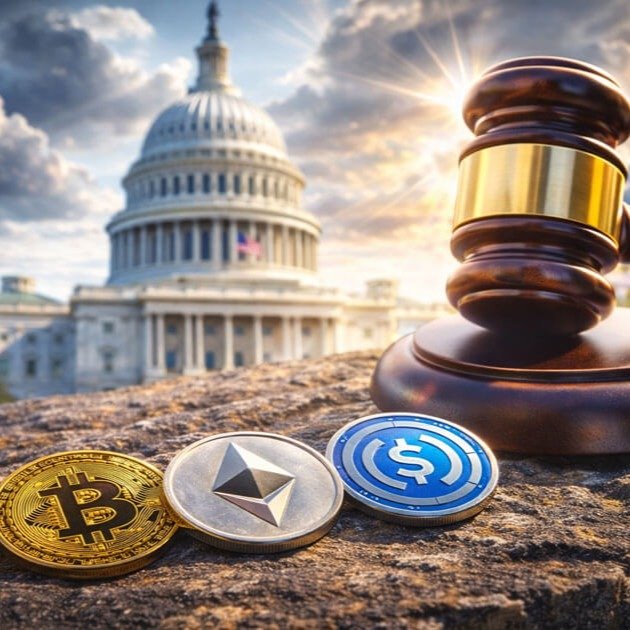
Crypto Market Structure legislation becomes law in 2026?
Foretrace AI research
Understand the odds. Examine the reasoning.
Polymarket shows market prices. Foretrace adds AI probability estimates, opposing evidence and a price-dependent outcome or pass decision for each open market.
Choose a market to analyze 1 open question · Evidence required
24h volumeUnavailable
Total volume$26.4K
Liquidity$8.3K
Event end date · UTCJan 1, 2027
Price history
Market probabilityLoading price history…
Polymarket · UTC
Sampled market observations, not AI forecasts. Lines connect available observations. Legend values are current provider quotes; chart points may be older.
Outcomes & resolution rules
1 marketThese are market-implied probabilities, not AI forecasts. A displayed quote may differ from the price available for your order.
Crypto Market Structure legislation becomes law in 2026?Accepting ordersMarket odds8.5%
Crypto Market Structure legislation becomes law in 2026?
Yes8.5%Polymarket estimate
No91.5%Polymarket estimate
- Liquidity
- $8.3K
- Deadline · UTC
- Jan 1, 2027
- Yes bid / ask
- 8.0¢ / 9.0¢
- Trading fees
- Enabled · verify on Polymarket
Get the Foretrace AI forecast
See a probability estimate with uncertainty, the evidence for and against it, and a conditional decision at the available price.
Fresh successful report: 1 credit. Valid shared report: free.
Resolution rules
This market will resolve to “Yes” if crypto market structure legislation is enacted into U.S. federal law by December 31, 2026, 11:59 PM ET. Otherwise this market will resolve to “No.” "Crypto market structure legislation" refers to any legislation that does all of the following: 1. Establishes a comprehensive regulatory framework for digital assets, cryptocurrencies, or virtual currencies (not solely for stablecoins); 2. Delineates regulatory authority between federal agencies (such as the SEC, CFTC, or others) for oversight of digital assets; 3. Creates definitions, classifications, or categories for when digital assets are considered securities, commodities, or other regulatory classifications. Examples of qualifying legislation include the "Digital Asset Market Clarity Act of 2025" (H.R.3633) and "The Financial Innovation and Technology for the 21st Century Act" (FIT21). The following would not qualify: - Bills that solely regulate stablecoins without addressing broader crypto market structure; - Bills that only ban or restrict specific crypto activities without creating a regulatory framework; - Bills that only address Central Bank Digital Currencies (CBDCs); - Appropriations bills that merely fund crypto-related activities; - Bills that only address crypto taxation without market structure provisions; - Executive orders, regulatory guidance, or agency rules; - The GENIUS Act or STABLE Act (stablecoin-only legislation); - The Anti-CBDC Surveillance State Act (CBDC-specific); Qualifying legislation may be enacted through passage by the United States House of Representatives and Senate and subsequent signature by the United States President, or through other formal means which constitute enactment into United States Federal law (e.g., veto override). The resolution sources for this market will be official information from the United States Congress and the United States President and a consensus of credible reporting.